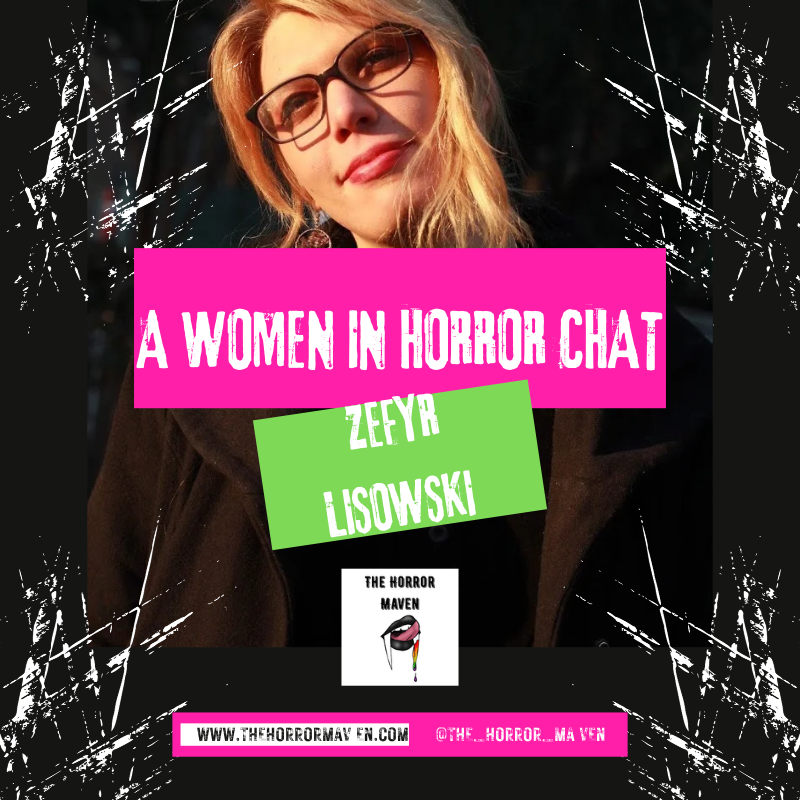
Zefyr Lisowski is the author of Uncanny Valley Girls: Essays on Horror, Survival, and Love, which has become one of my favorite non-fiction horror collections.
It is visceral, touches on so many different horror characters and films through the author’s personal experiences, and is a vital read for anyone who appreciates exploring horror through a queer lens. My review will be available soon, but please enjoy my interview with Zefyr in the meantime!

Synopsis
“In these extraordinary essays, Lisowski reads the entrails of her life like a witch and invites you along for the ride. How could you say no?” —Carmen Maria Machado
From Lambda Award-winning poet Zefyr Lisowski, a sharply personal and expansive memoir-in-essays dedicated to the strange and absurd beauty of horror films, exploring the complications of gender, the insidiousness of class ascension, and the latent violence hidden in our own uncanny reflections.
This is how it worked: first I loved them, and then I loved myself.
At twenty-seven, poet Zefyr Lisowski found herself in the place she feared most: a locked psych ward. While inside, she turned to horror movies—her deepest, most constant comfort.
Rather than disturb, scary movies have always provided solace and connection for Lisowski, as they do many others—offering a vision of a world filled equally with beauty and pain, and a reason to reach out to others and hold them tight. After all, as Lisowski argues, what terrifies us most about these movies is our own uncanny reflection—and at the root of that fear, a desperate desire to love and be loved.
In these wide-ranging essays, Lisowski weaves theory and memoir into nuanced critiques of films such as The Texas Chain Saw Massacre and Saint Maud. From fears about sickness and disability, to trans narratives and the predator/victim complex, to the struggle to live in a world that wants you dead, she explores horror’s reciprocal impact on our culture and—by extension—our lives. Through it all, Lisowski lays bare her own complex biography—spanning from a trans childhood in the South to the sweaty dancefloors of Brooklyn—and the family, friends, and lovers that have bloomed with her into the present.
Deeply felt, blood-spattered, and brimming with care and wonder, Uncanny Valley Girls investigates the art of horror—and of the self—with brilliance and wit, blending the two topics seamlessly with essays such as:
- “Ghost Face,” exploring the legacy of whiteness in Scream from the vantage point of the author’s childhood in coastal North Carolina.
- “War on Terror,” outlining how the violence of the Iraq War and its legacy of torture impacted the films of that era, such as Final Destination, House of Wax, and Turistas.
- “Southern Fried,” an ode to the author’s beloved Texas Chain Saw Massacre and how the film’s simple beauty and cruelty shaped the author’s relationship with the South.
- “Preliminary Materials for a Theory of the Werewolf Girl,” a complication of the werewolf as an inherently masculine form—and of the uneasy distinctions of victim and perpetrator—through the lens of films like Ginger Snaps and Angela Carter’s “The Werewolf.”
- And more.
Interview
Sage Moon: Zefyr, your book Uncanny Valley Girls: Essays on Horror, Survival, and Love resonated with me on so many levels. As a gender diverse person with disabilities, trauma, and more, I have always found horror to be a solace in such a distinct way. Reading your essays felt like looking in a mirror. What led you to write such an intimate collection?
Zefyr Lisowski: Thank you so much for the kind words about the book! Uncanny Valley Girls starts in a psych ward and ends in upstate New York at a writing residency, sharing a different kind of space with others. As such, writing this book was an act of community building, of willing my own survival into existence—but also it was an attempt to articulate one of the things I find most compelling about horror.
Horror, too, provides a mirror to view ourselves in.
In terms of the intimacy of the book, I’m deeply concerned with the idea of stakes in writing. If a writer doesn’t have a clear set of stakes, an investment in the story they’re telling, the writing falls flat. Much as I wanted to make a book about survival, about fear and fear’s aftermath, I also wanted to make something as complex and alive as me and the people I love are too.
SM: I am a mental health professional and frequently utilize horror in my bibliotherapy work with my clients. I have always found that it is so helpful for managing anxiety and exploring trauma, but your essays opened my eyes to just how big of an impact it has on those of us with disabilities of any kind – which was healing for me to read. You touched on so many different movies and horror characters in your collection, but which horror character would you say you feel closest to regarding your experience?
ZL: I’ve written a lot about Samara Morgan from the American version of The Ring—as a child who was also medicalized, in my case for a nonspecific seizure disorder, I was familiar with the endless dread of hospitals, which the movie captures so well. But what I find so disturbing about The Ring is its ending, how it justifies the isolation and eventual murder of the girl in the well by positioning her as ontologically evil. As a trans woman, I’m aware of the hatred that circulates towards many like me, and aware of the way the strength that paradoxically gives us as well. The fact that Samara continues to endure—and more than that, via the cursed videotape, literally tell her story—I find hopeful, even as the film views it as a site of fear.
SM: Historically, horror has villainized women, people of color, those with disabilities, and quite frankly, anyone who is considered “different” – which you highlighted beautifully in your collection. Leatherface is my favorite horror character for so many reasons, and a lot of it has to do with my gender, disabilities, experience as a neurodivergent person, trauma, and my relationship to my family. He is a character who could be considered as “different” as his victims. Do you think that Leatherface’s character has been less popular than other horror villains due to his differences?
ZL: I love Leatherface so much! I think we see a lot of complexity in his portrayal in the original Texas Chain Saw—there are these small moments of interiority that I really love in the film, especially in the more domestic role he operates in contrast to the rest of his family. But what is so striking about Leatherface is his softness—the fact that he wears makeup, that he is tormented by his family too. He’s strikingly feminized throughout the film despite being 6’7” in cowboy boots, as actor Gunnar Hansen was. That element of him was lost in most of the sequels and remakes that I saw, in part because—as you note—of that difference. I think that confusion in later films is linked to this for sure.
SM: An important point you touch on in your collection is how horror highlights the idea of trying to survive in a world or situation that wants the characters dead. This is so relevant for the queer community – especially now. What would you say to queer folx who are struggling to keep going when there is so much escalated hate towards our community?
ZL: I think our mutual survival and interconnectedness is of the utmost importance right now—not just through staying alive (although I vigorously believe in the importance of staying alive) but also resisting any calls to sanitize or decomplexify our lives. Queer people can hurt other people, can inflict similar harms to the ones that have been inflicted on them, but that doesn’t negate the importance of their continued survival. This is something I myself always try to keep in mind, and in many ways is the main thrust of the book. Thank you so much for noticing that!
SM: What is one horror film you would recommend to anyone in the queer community, and why would you choose this film?
ZL: Honestly, Saint Maud, directed by Rose Glass (the same director as Love Lies Bleeding!). It’s a really beautiful film about the agony of the closet and the mistaken belief that the pain of suppression—or the pain of explicit acts of self-harm—can ever be positively transformative. I love it so much and think it provides a necessary corrective to a lot of media that centers our pain as a virtue in and of itself. It’s also gnarly, which as someone who likes when movies go there endears it to me as well.
About Zefyr Lisowski

Zefyr Lisowski is a Lambda award-winning trans and queer writer, artist, and North Carolinian living in New York City. A 2023 NYFA/NYSCA Fellow and 2023 Queer|Art Fellow, she’s the author of the poetry collections Girl Work, winner of the 2022 Noemi Book Prize, and Blood Box, winner of the Black River Editor’s Choice Award from Black Lawrence Press. Zefyr’s work has appeared in The Believer, Electric Literature, Catapult, Literary Hub, Split This Rock, and elsewhere. From 2016 to 2024, she served as poetry co-editor for the Whiting Award-winning Apogee Journal. She’s seen grave robbers twice.
Leave a Reply