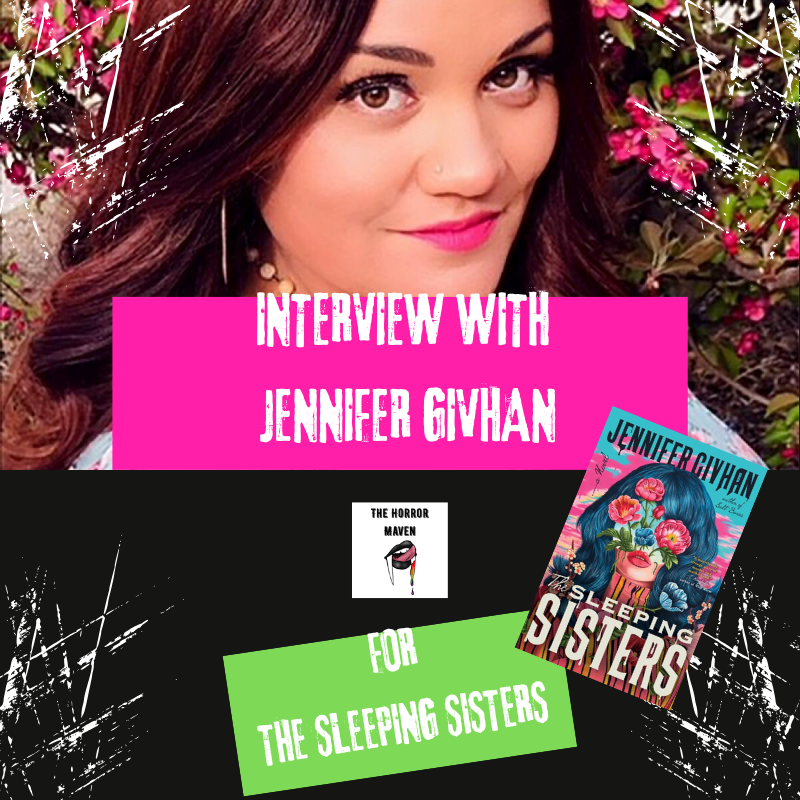
Last year, I had the privilege of reading Salt Bones by Jennifer Givhan and connecting with her. With a background in poetry, Jenn’s writing is lyrical, haunting, and gorgeous. Her writing is beyond vital in the times we are living in. Jenn writes from her Indigenous, Mexican American background, highlighting her beautiful community combining folklore with true to life horrors. While I had said last year that Salt Bones was the most vital book for anyone to read if you read nothing else, I want to emphasize the same thing about her upcoming book, The Sleeping Sisters. It may have become my favorite book of all time.

The Sleeping Sisters comes out on August 18, and any pre-orders will help the success of this gorgeous novel. Unfortunately, Salt Bones did not sell enough copies and may not be published in paperback, which has caused Jenn a lot of heartbreak. If you would like to support her, please consider pre-ordering The Sleeping Sisters.
Synopsis
A threatened mother and a relentless detective collide when a series of murders awaken something long buried in the New Mexican desert in this mesmerizing novel of literary horror, perfect for fans of Carmen Maria Machado and Stephen Graham Jones.
“A marvelously strange story of murder and motherhood. . . . I have no idea how to describe what I just read, but it was really, really cool.” –T. Kingfisher, author of What Moves the Dead
A mother’s love is the oldest curse
Fortuna Miércoles has finally moved her family to a better neighborhood across the Rio Grande, desperate to outrun the curse that’s stalked her bloodline since her greatest grandmother crossed the desert with a cactus thorn splitting her throat. But burying a family’s violent legacy–or her own haunting secret–isn’t so easy. Twenty years ago, girls and women vanished into the Albuquerque night, their bones later unearthed on the mesa. The so-called Reaper was never caught. Now, beneath the dormant volcanoes called the Sleeping Sisters, the killings have begun again, and they’ve called forth something in Fortuna that she has long fought to keep buried…
Detective Jeanette Palacio has spent decades promising justice to the ghosts of her murdered cousins–alongside the memory of the other women she couldn’t avenge. When a new body turns up in Fortuna’s backyard, both women are pulled into a dangerous, ancient plot. Are the Sleeping Sisters awakening–or has someone in Fortuna’s family set a trap?
Inspired by true events, The Sleeping Sisters begins as a taut mystery shot through with myth and a Chicana-Indigenous reimagining of the legend of the headless woman–but by its cataclysmic end has spiraled into a fevered, feral hymn to motherhood and a mesmerizing portrait of trauma and the monstrous bargains we make to protect those we love.
Interview
1) Jenn, THE SLEEPING SISTERS is one of the most profound and beautifully written novels I have ever read. You incorporated folklore with some very heavy and relevant themes. Can you tell me what led you to write this novel?
I felt deeply called to write this book, guided by the spirits of the girls and women who were exhumed on the West Mesa beneath the Sleeping Sister volcanoes in the desert beyond my backyard. In addition, Coatlicue was definitely a guiding force when reimagining the fates of the real girls and women into the fiction of the novel. She is the Mexica goddess of creation and destruction, the cycle of birth and rebirth, and her inherent restoration of that which she by nature must also tear down spoke to me on a powerful level as a motherwriter.
Fifteen years ago, on a hike from my home toward the Sleeping Sisters, someone told me of the women and girls buried here, but the callous way they spoke about the deceased, calling them “hookers,” gnawed at me. I wasn’t upset that the girls and women had performed sex work in life. Only that the person had defined them by their work. As if whatever they’d done to survive before their gruesome murders and subsequent burials in a mass, unmarked grave in the desert under the watchful eye of the volcanic Sleeping Sisters had encapsulated them. The fellow hiker had called them “hookers,” and I’d heard “daughters.”
This novel sets out to right that wrong, among countless others.
2) I almost annotated this entire book; your prose is that exceptionally powerful and gorgeous. When writing about such heavy topics, do you find that writing through poetic language with your background in poetry is easier or more powerful as a writer?
I am a poet. Deep down I believe all writers are, ha!
Everything I create pours out in poetry, and sometimes when prewriting I draft my scenes and chapters as poems I later translate into prose. The process for releasing the lyrical is that I tell myself (and my high-school-aged daughter, who homeschools, joins in with me): today I’m going to write something ugly, something monstrous. I’m going to release a beastie onto the page. I wrap a metaphorical umbilical cord around my waist, tied securely to my family and faith, then light a candle and ask my Ancestors and benevolent spirits to guide me as I dive into the deep, dank caves where the duende resides, that hobgoblin we must battle with, says Frederico Garcia Lorca, and be willing to die wrestling in order to bring back anything worthwhile to the surface. In order to bring back poetry.
To create The Sleeping Sisters, and all my novels, I braid this process with several others, including much more analytical outlining and plotting sessions, often aloud with my family, jotting copious notes into one of the many notebooks I keep while planning, drafting, and editing each book, along with the tangible aspects of mapping out ideas, which often includes actual maps, terrible stick-figure sketches, and pinning things to my walls like some maniac with a bundle of red string. I live with and within each story, becoming a channel for it, until my editors say I must finally declare this last round the final final draft and any other edits would cost me!
Even now, though, I wish I could go back and revise some more.
3) The main character of your novel’s name is very close to your own, was this intentional?
No, it was not necessarily intentional; she just appeared fully formed. Jeanette quite literally beamed herself onto the page one day. I’d been writing from Fortuna’s POV but all of a sudden, I was like, who’s this? I’d been home alone (which is rare) and as soon as my family pulled into the driveway, I ran out barefoot onto the scalding concrete and shouted,
“You’ll never guess who manifested herself into the novel!”
The story gods had gifted Detective Jeanette’s perspective to me, and I was a little panic-stricken that now I had to write a police procedural, weaving a cop’s voice through my folk horror and myth-making! But she was truly such a wonderful character I loved inhabiting, and so many story paths opened between her and Fortuna once they were both on the page. And she forced me to strengthen my procedural chops! And when Jeanette’s cousins showed up, we had a party! They started calling her Jenny—and I knew a special act of magic had taken place. I always long for meta aspects woven into my books since I love them so much but never want to get too heavy-handed or didactic. That this all came organically and all I had to do was accept? What a gift.
Jenny and her primas ended up deeply resonating with my heart, and I cry with joy every time I get to the end of their chapters.
4) I didn’t think that I could find a book more searing, relevant, or haunting than SALT BONES before reading THE SLEEPING SISTERS. However, I was deeply mistaken. What is your process like when writing heavy elements that incorporate your Latina and Indigenous culture? Do you need to take breaks in between writing sessions?
I’ve expounded on this above, but I’ll add that I give myself as many rest periods as possible and offer myself grace wherever I can. For The Sleeping Sisters, I was under contract; it was the first time I’d written this way, with a strict deadline I felt financially obligated to uphold, which gave me a certain amount of freedom since I knew I had to finish in a specific timeframe, so I could truly let out whatever monstrosity was inside of me onto the page, since, as I often remind my teenage children, who are both writers: We can do something with something and nothing with nothing.
Thus, I reminded myself daily, I’m not writing a masterpiece. And somehow, now, my respected colleagues are saying this is my masterpiece.
I think the trick is telling ourselves this thing we’re working on can be ugly; it can be whatever it needs to be, as long as it’s out of us where we can shape it into something beautiful.
we free ourselves to dig up all the treasure inside us, when we believe it’s just rocks. And then we can polish until those rocks are shining, and maybe even—with all the pressure of our experiences, culture, heartwork—they’ve actually been diamonds within us all along.
5) With everything that is going on in this country, particularly with Latine/Hispanic folx, what do you hope your novel will bring to readers during such a difficult time in our history?
I hope that Latine and Indigenous people will see ourselves in my work.
I write for our community, to uplift us. As I said above, I try not to put too much external pressure on the work itself, or I might never be able to write. It’s such a painful time, and it often feels like the work could never be enough to create concrete change and bring about true transformation.
But our writing, our speaking out, our singing into the abyss, holding each other as we refuse to let our voices cease or our lights extinguish—that’s the work. That’s the miracle. It’s us.
We are the magic and the strength and the way through.
About Jennifer Givhan
Jennifer Givhan is a Mexican-American and Indigenous poet and novelist from the Southwestern desert and the recipient of poetry fellowships from the National Endowment for the Arts and PEN/Rosenthal Emerging Voices. The Los Angeles Times called her novel Salt Bones (Mulholland/Little, Brown, 2025) “a triumph… one of the most masterful marriages of horror, mystery, thriller and literary writing” and it’s a Publishers Weekly Best Book of the Year, a Book Riot Best Mystery & Thriller of the Year, a Marie Claire Best Mystery-Thriller of the Year, a Library Journal Stellar Selection, and an American Library Association Best Book of the Year.
Her newest novel The Sleeping Sisters is coming this August 18th from Little, Brown.
She holds a Master’s degree from California State University Fullerton and a Master’s in Fine Arts from Warren Wilson College. She is the author of five full-length poetry collections, including Rosa’s Einstein (University of Arizona Press) and Belly to the Brutal (Wesleyan University Press), and the novels Trinity Sight and Jubilee (Blackstone Publishing), which were finalists for the Arizona-New Mexico Book Awards and won The Southwest Book Award. Her novel River Woman, River Demon was chosen for Amazon’s Book Club and as a National Together We Read Library Pick and was featured on CBS Mornings. It was a finalist for the Spur Award for Best Contemporary Western Novel and won an International Latino Book Award in the Rudolfo Anaya Latino-Focused Fiction category.
Her poetry, fiction, and creative nonfiction have appeared in The New Republic, The Nation, POETRY, TriQuarterly, The Boston Review, The Rumpus, Salon, Ploughshares, and many others. She’s received the Blue Light Book Prize from Indiana University Press chosen by Ross Gay, the Pleiades Editors’ Prize, New Ohio Review’s Poetry Prize chosen by Tyehimba Jess, Phoebe Journal’s Greg Grummer Poetry Prize, the Pinch Journal Poetry Prize chosen by Ada Limón, and Cutthroat’s Joy Harjo Poetry Prize.
Givhan has taught at the University of Washington Bothell’s MFA program as well as Western New Mexico University and has guest lectured at universities across the country. She was the 2024 Visiting Professor of Creative Writing at The University of New Mexico.
She writes in Albuquerque with her family.
Leave a Reply