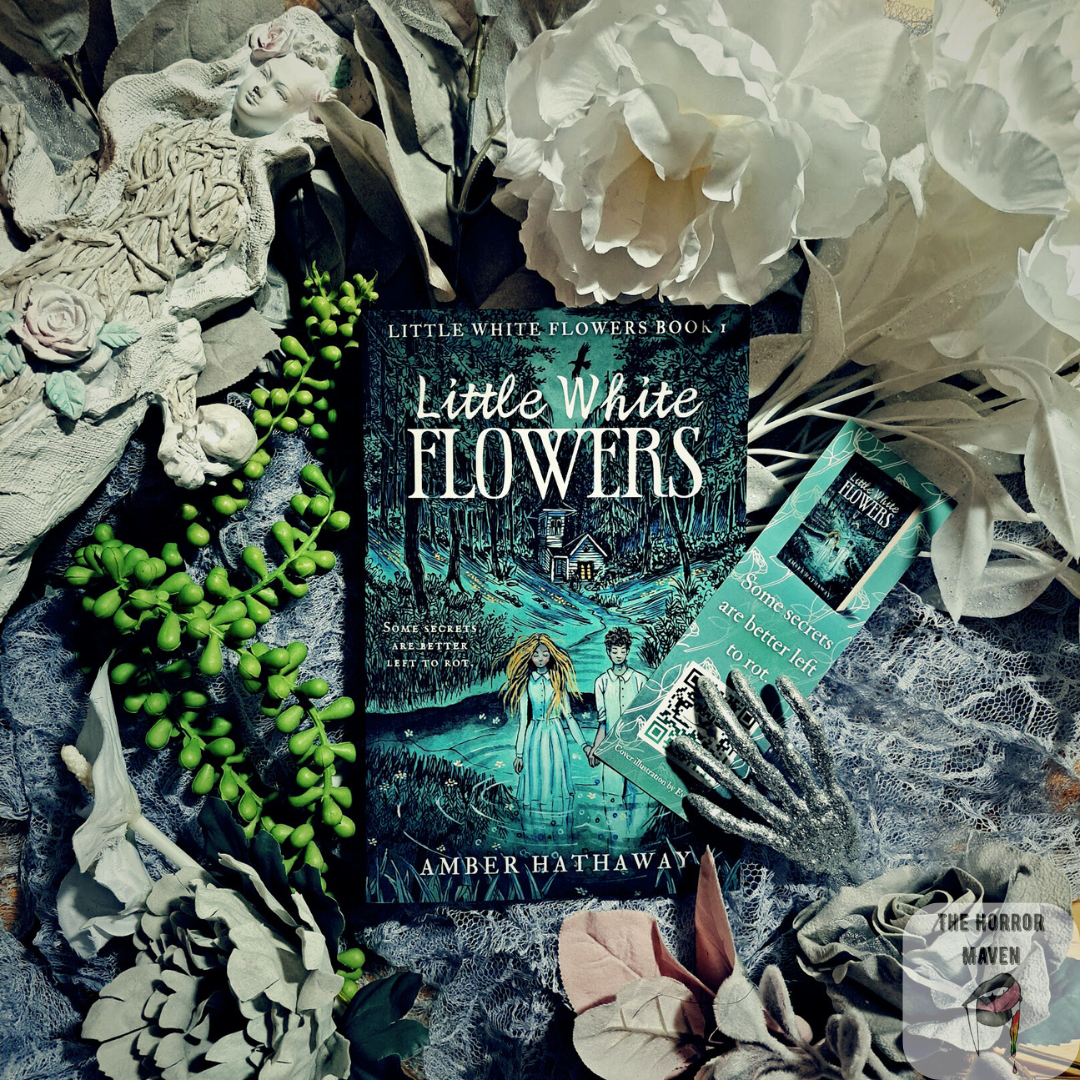
Little White Flowers Book 1 by Amber Hathaway

Synopsis
Some secrets are better left to rot.
When she and her brother venture to Evanston, Maine to clean out an estranged relative’s estate, horror enthusiast Alice Drayon’s life begins paralleling her favorite page-turners. The sojourn in their grandmother’s “wicked” hometown provides the perfect opportunity for Alice to delve into Grammie’s mysterious past. However, she soon discovers that the horrific event that drove Grammie away is but one small piece of the town’s blighted history.
Confronted with increasing hostility from Evanston’s insular religious community as she closes in on the truth, Alice must risk everything to save lives. Her soft-spoken new neighbor, Riley Moore, seems to have answers … and some dark secrets of his own. Can Alice trust him to help her put an end to Evanston’s wicked practices, or will she become yet another casualty?
Little Eve meets “The Lottery” meets “Children of the Corn.”
Perfect for readers who love:
- Slow burn horror
- Family secrets
- Creepy small towns
- Religious cults
Overall Rating
5/5
Spooky Rating
4/5
Quick Take
I don’t often call books flawless, but when it comes to Little White Flowers, there is no better word to describe it. It is atmospheric, relatable, painful, and made for this forever fan of Stephen King’s “Children of the Corn” and Shirley Jackson’s “The Lottery.”
Tell Me More
Little White Flowers by Amber Hathaway is one of those rare horror novels that gets mental illness and mental health concerns strikingly right. This is certainly due to the author’s experience living with some of the conditions she incorporates into her story. While she highlights mental illness (extreme anxiety, panic attacks, and substance abuse), she also highlights autism and neurodivergence. It is a book that will resonate with those of us living with these conditions – some of which I live with myself. But she does something that so many other authors struggle with. She portrays them in a way that those who don’t live with these conditions will gain some understanding of how hard they are to manage day to day. She does this by providing descriptions that puts the reader into each character’s shoes.
“Why was interacting with people so difficult? Sometimes it felt like everyone else had acquired a manual telling them what to say and when, and no one had bothered to share a copy with her.”
Folk horror is my favorite subgenre of horror. This is largely due to its quiet and eerie nature. It worms its way under your skin and attacks you from within before you know what is coming. Not to mention that it usually focuses on religious themes, which resonates well with those of us who have religious trauma. Little White Flowers incorporates religious themes in a classic way that are used well within Hathaway’s take on folk horror. It will resonate well with the queer community of which Hathaway is part of. She also handles religious themes of the sect she presents well because she does so in a way as to not re-traumatize her readers.
“It was just a house. Wood and metal. Those bad vibes were her imagination doing what it did best: reconfiguring the mundane into the menacing. If every place that had seen trauma carried a memory of its past, the entire world would be uninhabitable.”
Trauma is a sensitive focus of Hathaway’s novel, particularly in the form of domestic violence, sexual assault, and religious trauma. My experience with a lot of horror novels is that these forms of trauma can sometimes be used as a shock factor, rather than an essential element to the story. As a survivor of both religious trauma and multiple sexual assaults, l usually find this unnecessary or bordering on cruel. But Hathaway presents trauma in a way that is essential to the story. While she incorporates these sensitive subjects, she doesn’t use them to hold the reader hostage in a world of true to life horror. Her insight into how trauma can permeate the places where it takes place gave me chills, because I feel that way about places where my traumas have taken place. Hauntings don’t just involve ghosts, they can be caused by events, and that is one of the scariest realities of them all – what remains when the people involved are gone, because the event lingers.
“This was where it happened. Abuse, murder, whatever transpired all those years ago. It was a statistical reality – abuse most often occurred inside the home – but there was something deeper too, as though the trauma lingered still, its malignancy poisoning the air.”
Hathaway’s care for her readers is evident in her detailed content note at the beginning of the book, which is more than necessary for the mental health of every horror reader. This is something that I speak strongly about including, despite the constant debate about providing content warnings in the horror genre. While Little White Flowers is the first in a series, it introduces us to the depth of each character and the air of mystery surrounding their circumstances. Hathaway focuses on characters who have mental health struggles but does not portray them as weak.
Instead, she presents them as powerhouses fighting back against forces designed to destroy them and feeling othered based on their experiences and conditions.
Leave a Reply