
Happy Indigenous Peoples’ Day!
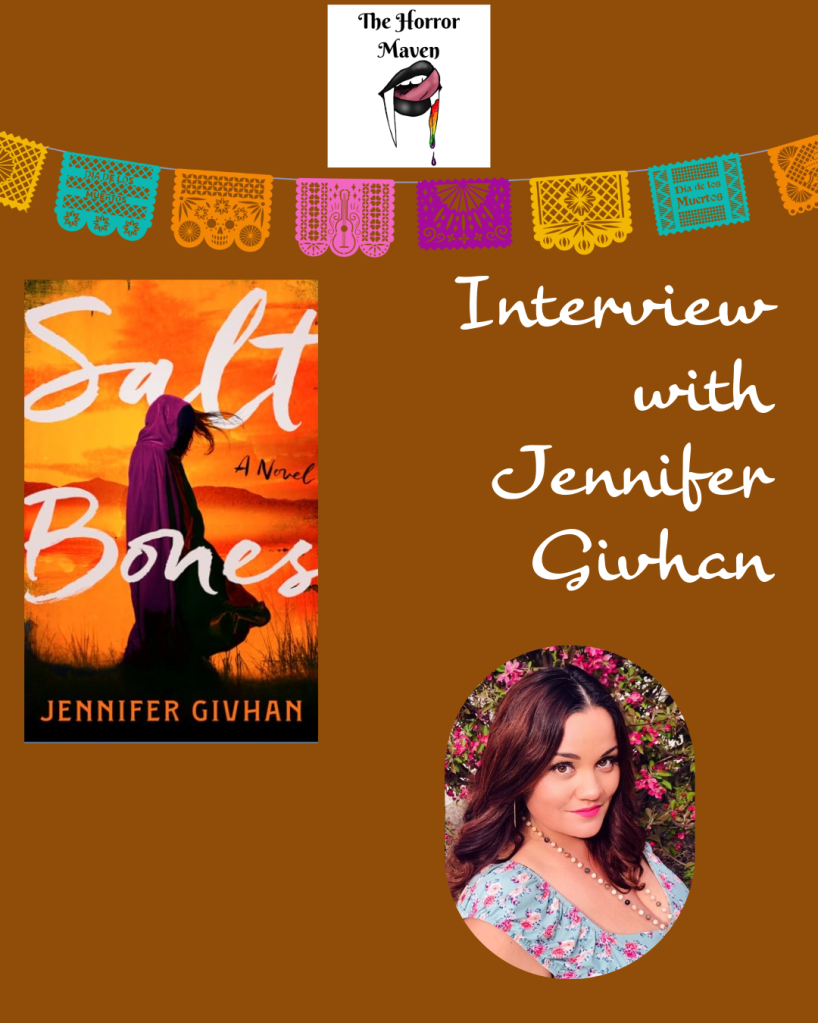
To celebrate, I saved my full interview with Jennifer Givhan, author of Salt Bones to share on this day. Jenn is indigenous and Mexican American, and she is such an incredible woman, poet, writer, and advocate. We are both fibromyalgia warriors and have connected on a deep level.
Salt Bones is one of the few books that I demand everyone read – especially now – and I hope that reading through our interview will give you insight into how powerful this story is.
Synopsis
Three women in one twisted family race for answers in this striking mystery set in the Mexicali borderlands that “breathes new life into the myth of Persephone and Demeter” (Ana Reyes, author of The House in the Pines).
At the edge of the Salton Sea, in the blistering borderlands, something is out hunting…
Malamar Veracruz has never left the dust-choked town of El Valle. Here, Mal has done her best to build a good life: She’s raised two children, worked hard, and tried to forget the painful, unexplained disappearance of her sister, Elena. When another local girl goes missing, Mal plunges into a fresh yet familiar nightmare. As a desperate Mal hunts for answers, her search becomes increasingly tangled with inscrutable visions of a horse-headed woman, a local legend who Mal feels compelled to follow. Mal’s perspective is joined by the voices of her two daughters, all three of whom must work to uncover the truth about the missing girls in their community before it’s too late.
Combining elements of Latina and Indigenous culture, family drama, mystery, horror, and magical realism in a spellbinding mix, Salt Bones lays bare the realities of environmental catastrophe, family secrets, and the unrelenting bond between mothers and daughters.
Interview
Sage Moon: Jenn, your book, Salt Bones, broke my heart and made my soul ache in all of the best ways. The added folklore element of La Siguanaba (the horse headed woman) brought such a unique theme to this genre bending novel. While I have seen La Llorona incorporated into many horror works, I had never heard of La Siguanaba before reading your book. What made you choose her for this story?
Jennifer Givhan: A fellow writer and I were once laughing about how people ask if we write fantasy, horror or magical realism. All of that might be true, but for us, we are also just writing about our childhoods as he grew up in the Caribbean and I was born and raised on the Southwestern border. Most of my books focus on La Llorona, and you’d think that with the Salton Sea being a prominent feature of this newest book Salt Bones that she would have appeared again. But I do feel like she’s in the subtext and heart of everything I write, and it was time for another monstrous mama to make herself known.
Enter La Siguanaba.
I don’t want to give too much away about this monstrous mama and how she haunts this story. But I will say that my daughter fell in love with horses and we’ve spent a lot of time together at the horse pens, arenas, and trail rides along the Rio Grande. So I honestly became as haunted as Mal in terms of horses. As with many of my novels, the characters in their landscapes come to me and ask me to tell their story. The myth of La Siguanaba grew inside of me as Mal’s story unfolded along the Salton Sea, along with El Cucuy and los chupacabras and many of the other so-called monsters that roam through the Mexicali borderlands where I grew up.
I’m especially interested in how cultural stories evolve and migrate, how they get retold and reshaped to reflect new dangers, new hauntings, new hopes. The Salton Sea, as it dried and the fish began to die en masse, became covered in bones—millions of them—which locals call “hash.” They look disturbingly like human teeth. I remember visiting, walking along the shore, hearing that awful crunch under my boots. I’d wear a mask because the air was toxic. And in those moments, the image of a skulled, faceless, horse-headed woman began to haunt me.
I’d heard stories that she went after bad men, drunkards and womanizers out in the dead of night doing things they shouldn’t have been doing; but I’d also heard that she went after children – specifically girls. This caught my attention and made me wonder.
So that’s where I dug in.
SM: When I came to your author talk recently, you discussed the Salton Sea and its history – which is an important element in your novel. Can you provide some of that insight for readers?
JG: In the 90s, I grew up near the ancient saline basin once called Lake Cahuilla, which has filled and emptied over millennia in the Southern California desert. In the early 1900s, it was unintentionally remade into the Salton Sea after two floods and a broken dam channeled irrigation water from the Colorado River. By the time I was a kid, ninety years later, my mama warned us it was poison. We could smell for ourselves the fish die-offs, the weeks-long stink of toxic algal blooms.
After I left for college, got married, and had kids, I returned to my hometown to visit my comadre, my bestie. She told me that the Salton Sea was drying up and releasing toxic chemicals like arsenic from decades of pesticide runoff, which had sunk into the lakebed, aerosolized, and wafted into the lungs of everyone still breathing throughout the community. The whole Valley could become a ghost town, she said. If nothing was done.
I started researching, and over the next decade, I became increasingly concerned about the fate of the place that raised me. It has been featured in shows like Abandoned America, although the mostly Mexican community is still thriving, even as the farm-owning elite bring in billions in agricultural revenue each year. All while the so-called accidental lake poisons the air. When activists went up to Sacramento to ask for help, for instance, legislators had been overheard justifying their apathy with remarks like, “No one lives down there anyway.”
But we do!
I knew I had to tell this story. My soapbox may have been slippery, but people tend to love murder mysteries. So I wrapped my heart in one.
SM: Salt Bones focuses a lot on generational trauma, motherhood, racism, and the experiences of indigenous women. Reading this novel from the perspective of Mal, a mother deeply impacted by her own mother’s abuse, provided such an important perspective. Do you have insight into the difficulties women face as mothers when they still hold trauma from their own mothers?
JG: I’ve been obsessed with this story for years, probably in many ways because it represents my greatest fear – being separated from my children – whether through what happens in Salt Bones or through death. Another aspect of my writing has been to work through fear alongside mental health issues, past traumas, and grief – holding space for my own healing as I offer the truths I’ve dug deep into the underbelly to find, shaped as gifts for others who need them.
So as my motherhood poetics of healing intergenerational trauma evolved through my poetry and novels, I needed to delve deep into the underworld and boiling sopa pot of my mother’s stories, my community’s histories, my daughterhood, and my lived experience as a mother – including the powerful truths that my own children have taught me.
That descent became part of the work, and I found a certain line of poetry kept returning to me on this journey so it became the preface of Salt Bones. It’s from Eavan Boland’s “Pomegranate:”
“The only legend I have ever loved is / the story of a daughter lost in hell. / And found and rescued there.”
El Valle became both the hellscape and the place of restoration, rescue, and rebirth, through Mal’s motherwork.
Realizing the sick roots at the heart of the story hurt like hell, but it was a painful truth I couldn’t turn away from. I had to stay strong, like Mal, for her girls. “Don’t look away,” I’d remind myself while writing.
So Mal’s journey enlightened and healed me in many ways, as she’s a strong and flawed badass mama who protects her daughters and herself even after she’s messed up, and a lot of what she deals with as a mother stems directly from her own girlhood and how she was parented. Healing is not linear, but cyclical. We mamas can delve back into the underbelly, defying physics with our motherlove, and heal both past and present – making choices rooted in the refusal to look away.
Mal embodies my entire motherhood poetics, which sees the mother as capable of delving into the underbelly to heal her own trauma as a girl in order to heal and protect her daughters. The hellscape I drew from my childhood near the Salton Sea, along with its current state of wreckage, mirrors the mental health battles I fought throughout mothering my children, which I realized at some point paralleled my own mother’s, and hers, and hers… and so on.
There was this crystalline moment while I was asking my Ancestors for help weaving this story, one morning between dreamworld and waking, when I realized that I am the first daughter of a first daughter of a first daughter. There was a tremendous sense of responsibility to tell our stories and undo the trauma, but also a gift of strength and empowerment. I realized that while we absolutely do carry trauma embedded in our genes, wounds handed down through the womb, we also carry such perseverance, tenacity, and hope.
The work of decolonization and undoing trauma our families handed down to us from the trauma heaped upon them can sometimes become so soul-heavy, it feels unbearable. That’s when I know it’s time to rest and return to my family, go inward to my altar, or come back to writing, depending on where I am in the cycle. I remind myself that our stories have always been circular. We return to where we began, but with a new perspective.
The Western patriarchal messaging I’ve internalized, even unintentionally, can sometimes make me feel worthless or hopeless—a rat on a wheel, perpetually spinning. But then I remember that I’m a strong, powerful chingona on a spirit-led, heart-filled mission. My gift is motherwriting, mothering and writing inextricably linked.
Our mothers were fed the same poison they accidentally fed us. I have to remember that as I undo the conditioning of my girlhood and theirs, as I find myself making the same cyclical choices that came from the wound in my own mothering and then work toward repairing that and making new choices next time.
In part, I believe I’m called to write to show how things can be. While I know I’ve done the work of revealing the problems, part of me now wants to write toward the future and open new possibilities, tuning out the patriarchal messaging that tried, but failed, to brainwash or numb me.
Although my children are now teenagers (my son just graduated from high school, and my daughter just celebrated her quinceañera) there’s still time.
There’s still hope.
We can keep planting new seeds and tending the good we’ve already grown.
Both of my children write, for instance. My son has written several screenplays, and my daughter and I write middle-grade novels together, another example of how I center family in my writing, and how we’ve created a sustainable practice together.
So as I stop beating myself up and return to the wisdom of my Ancestors and Spirit, I can find joy in the writing and continue helping my children do the same.
We need joy. More than ever.
We fight hate and intolerance with love and acceptance.
We model the way things can be through our art, stories, and songs.
We imagine these spaces of love and hope and acceptance, we create them first in the mind and heart, then on the page or screen or canvas or stage, and those offer blueprints for how to live them and reshape societies around them.
That’s my fervent hope and what sustains me.
SM: Your background is rooted in poetry – and that shined through Salt Bones with your lyrical prose. What was your process with incorporating poetic language into the traditional novel format?
JG: I’m a poet at heart, and I have often discussed elsewhere how taken I am with Julia Kristeva’s theory of the semiotic, prelinguistic chora space of humming and crying and guttural noises and communicating beyond “meaning making” as a child/mother through the womb or in the newborn stages. I tap into this realm in my poetics. The same is true for the process of creating my poems, and as a woman with chronic illness, I often find myself in a state of exhaustion or brain fog (fibro fog).
Perhaps because I’m a poet at heart and partly because I’ve dedicated my life to studying the craft of poetry, creating the poems never feels like work, but freedom. Release, play, heartwork in its purest form. This is not to suggest I don’t craft and sculpt and revise a hundred times in a hundred iterations. I do. But it’s the kind of soul work that revitalizes and strengthens and buoys me so that I can return to other work – the novels and the rest of my life.
When I’m not writing poetry I don’t beat myself up, because I know that, like any true love, poetry will never leave me, and I will never leave it.
The heart of my novels is like poetry. The deeper themes and resonances, the humanity buzzing and humming in the characters and their relationships and desires and fears and resulting choices for better or worse, the beating heart at the center. But puzzling it all together, creating believable dialogue that moves the story forward and keeps the pacing clipped and the reader turning pages—all of this I’ve had to teach myself again and again. It does not always come naturally to me, and I’ve found I’ve had to forgive myself and be patient with myself. An analogy that’s helped me lately is that the writing process can be akin to a child happily at play building with blocks, stacking one atop the other, contentedly. One block at a time.
Poetry lives in my bones, and from that skeleton I start with voice, image, and rhythm, writing toward what hurts. Every novel feels like a long sonnet with a turn, that knife twist. Poetry has taught me to listen for silence and shape it into a story, while horror and mystery and magical realism live side by side in my psyche, the underbelly, especially for us marginalized folks. I have a craft essay in Writer’s Digest about how I wrestle with the duende and go deep into the chora space of the underbelly to dig up truths and craft not the hero’s journey but the mother’s.
I could go on and on about this topic but suffice it to say that my work in one genre feeds the other.
SM: I am chomping at the bit for more of your work, and I know you have another novel coming out next summer. Can you speak a bit about that novel and what readers can expect?
JG: I’ve just finished the draft of a new novel called The Sleeping Sisters that loosely recalls the serial killings of eleven girls and women here in Albuquerque where I live with my family on the Boca Negra mesa. It’s border noir meets gothic bones; a genre-bleeding fever dream inspired not only by reclaiming the lives of the girls and women here – whom I still see in the desert fields surrounding my house – but also by my first poetry collection Landscape with Headless Mama. She begged me to reweave her into prose, demanding more space and breath to sing her story. Since I have a deep penchant for so-called monstrous mamas, I’m bursting at the seams to share this newest novel with you all; it’s unsettling, breakneck, and as feral as a mother. It’s also my most unhinged storytelling yet!
Look for it Summer 2026 from Mulholland/Little, Brown!
About Jennifer Givhan
(she/her/ella/la bruja)
I am a Mexican-American and Indigenous poet and novelist (Salt Bones is available for preorder now), who grew up in the Imperial Valley, a small, border community in the Southern California desert. My family comes from the Indigenous peoples of New Mexico, Texas, and Mexico including Ysleta del Sur, the Tigua Indian peoples of the Ysleta region of El Paso, and the Huichol of Nayarit.
I earned my Master’s degree in Fine Arts in Poetry from Warren Wilson College in North Carolina and my Master’s degree in English Literature and Creative Writing at California State University Fullerton, where I was the recipient of the Graduate Equity Fellowship.
My honors include a 2015 National Endowment for the Arts Fellowship, a PEN/Rosenthal Emerging Voices Fellowship, The Frost Place Latinx Scholarship, a 2020 Southwest Book Award, an Honorable Mention for 2021 The Rudolfo Anaya Best Latino Focused Fiction Book Award category from the International Latino Book Awards Foundation, The 2019 New Ohio Review Poetry Prize chosen by Tyehimba Jess, Cutthroat Journal’s 2018 Joy Harjo Poetry Prize chosen by Patricia Spears Jones, The 2017 Greg Grummer Poetry Prize chosen by Monica Youn, The 2015 Lascaux Review Editors’ Choice Poetry Prize, and The Pinch Poetry Prize chosen by Ada Limón.
My poetry, fiction, and creative nonfiction has appeared in The New Republic, The Nation, Best of the Net, Best New Poets, AGNI, TriQuarterly, Ploughshares, POETRY, Boston Review, Crazyhorse, Blackbird, The Kenyon Review, New England Review, Salon, The Rumpus, and Prairie Schooner, among many others.
*Here’s a third-person bio for media use.
Here’s my poem “I Am Dark / I Am Forest” in POETRY.
My work tends toward magical realism and dark psychological motherhood that reflects back on an often darker sociopolitical landscape, but the shadow work exists to reveal the light, and that’s always my goal–to shine that hopeful light amidst the darkness.
Among my influences are Toni Morison and Ana Castillo, and some of my recent faves are Jesmyn Ward’s Sing, Unburied, Sing and Victor Lavalle’s The Changeling.
I write, mentor and empower writers, and raise my two children in Albuquerque, New Mexico (the Land of Enchantment) and often channel the magickal desert in my writing. *Note that I’m currently living in San Diego with my family (near the border and Imperial Valley where I grew up) as I research and write my next novel.

 thehorrormaven.com